Microcarriers in Cell Culture: Your Questions Answered

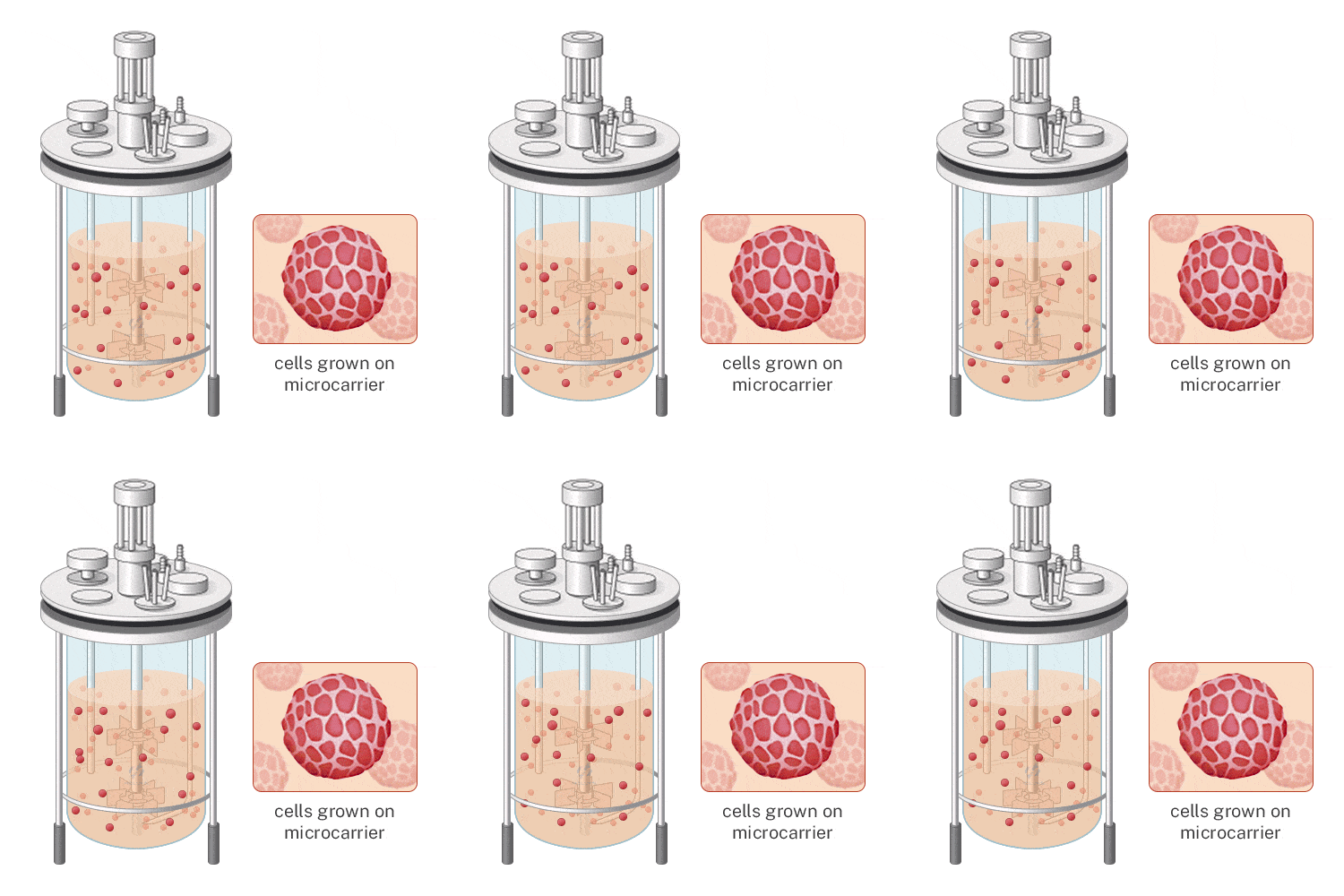
Microcarrier (Microcarrier) means a class of microspherical scaffolds with a diameter of 50-350 μm and a density slightly higher than that of water, which have biological functions such as cell culture, proliferation and delivery. During the process of cell value-added differentiation, it can adhere to cells and provide a support matrix for cells.
 
Q1: What are microcarriers and what purpose do they serve in cell culture?
 
A1: Microcarriers are small, inert particles that provide a surface for anchorage-dependent cells to grow in suspension culture. They are typically made from materials such as polystyrene or gelatin, and their primary purpose is to increase the available surface area for cell attachment and proliferation. This technology is especially beneficial for scaling up the production of cells for various applications, including vaccine production and regenerative medicine.
 
Q2: How do microcarriers enhance cell growth compared to traditional culture methods?
 
A2: Microcarriers enhance cell growth by providing a three-dimensional environment that mimics natural tissue structures. Unlike traditional two-dimensional culture methods, microcarriers allow cells to grow in a more physiologically relevant manner, which can lead to improved cell viability and productivity. The increased surface area provided by microcarriers also allows for higher cell densities, making them ideal for large-scale bioproduction.
 
Q3: What types of cells can be cultured using microcarriers?
 
A3: A wide variety of cell types can be cultured using microcarriers, including adherent mammalian cells (such as CHO and HEK293 cells), stem cells, and some types of insect and plant cells. The choice of microcarrier type can depend on the specific requirements of the cell line being cultured, including nutrient needs, growth characteristics, and desired outcomes for the culture.
 
Q4: What are some key factors to consider when selecting microcarriers for cell culture?
 
A4: When selecting microcarriers for cell culture, several factors should be considered:
 
Material Composition: The material should be biocompatible and suitable for the specific cell type.
Size and Surface Properties: Microcarrier size affects the settling rate and cell attachment efficiency. Surface modifications can enhance cell growth and productivity.
Culture Conditions: Compatibility with the growth medium and ease of sterilization are also important.
Scalability: Consider whether the microcarrier system can be easily scaled up for large-scale production.
Q5: How are microcarriers used in bioprocessing applications?
 
A5: In bioprocessing applications, microcarriers are utilized for the mass production of cells and biological products. For instance, they are commonly employed in the production of vaccines, monoclonal antibodies, and gene therapies. By facilitating high-density cell culture in bioreactors, microcarriers help optimize yield and efficiency, enabling the rapid production of therapeutic proteins and cells for clinical use.
 
HOLVES develops and produces a wide range of cell culture carriers, including not only dextran-based microcarriers (HCD-001 and HCD-001G), but also biodegradable soluble 3D carriers (HCD-003) and polyester fiber carriers (HCF-001 and HSD-001) to meet the user's individual needs in the cell culture and purification process, and to facilitate the innovative development of the biopharmaceutical industry.
 

More questions to solve?


More Questions

More Questions

Microcarriers in Cell Culture: Your Questions Answered

[VIRTUAL Address] Microcarrier (Microcarrier) means a class of microspherical scaffolds with a diameter of 50-350 m and a density slightly higher than that of water, which have biological functions such as cell culture, proliferation and delivery. During the process of cel...

Applications of Stainless Steel Fermenters in the Pharmaceutical Industry

[VIRTUAL Address] HOLVES Su310 intelligent stainless steel fermenter is a new generation of pilot and small-scale production equipment, integrating hardware innovation and intelligent control. In the pharmaceutical industry, stainless steel fermenters are crucial for produ...

Application of Ceramic Membrane Filtration

[Ceramic Membrane Filtration] Ceramic membrane filtration is a physical separation process that uses ceramic materials with porous structures to separate particles, microorganisms, and dissolved substances from liquids....

The Application of Tangential Flow Filtration Cassettes

[Tangential Flow Filtration] The Application of Tangential Flow Filtration Cassettes...

Everything You Need to Know About Four-Piston Diaphragm Pumps

[Four-Piston Diaphragm Pumps] What is a Four-Piston Diaphragm Pump? How Does a Four-Piston Diaphragm Pump Work? What Are the Key Advantages of Four-Piston Diaphragm Pumps?...

Lab-Scale Photobioreactor Systems and Their Applications in the Laboratory

[Photobioreactor] Photobioreactors are specialized cultivation systems designed to grow photosynthetic microorganisms such as microalgae, cyanobacteria, and other photosynthetic cells under controlled environmental conditions. Lab-scale photobioreactor systems serve as...

Microbial Fermentation Control Systems: Optimizing Fermenters for Enhanced Production

[Fermenters] Optimizing Fermenters for Enhanced Production...

Biological Reactions in Bioreactors: Advanced Solutions for Efficient Fermentation

[Bioreactors] Biological Reactions in Bioreactors: Advanced Solutions for Efficient Fermentation...

Tangential Flow Filtration and Its Applications

[Tangential Flow Filtration] Tangential Flow Filtration (TFF) is a separation process widely used in various industries, especially in biopharmaceutical manufacturing, water treatment, and chemical processes....

Small Spray Dryers Basics

[Small Spray Dryers] Learn the Basics of Small Spray Dryers...

1/2

Contact

MyDreamPlus 4/F, Changying Future Building, Chaoyang District, Beijing – China

+86 (10) 64919358
Contact us

Twitter Facebook Wechat

Our website uses cookie to improve usability. By clicking “Accept”, you consent to the use of ALL the cookie. For more information, please click here.

Accept Close