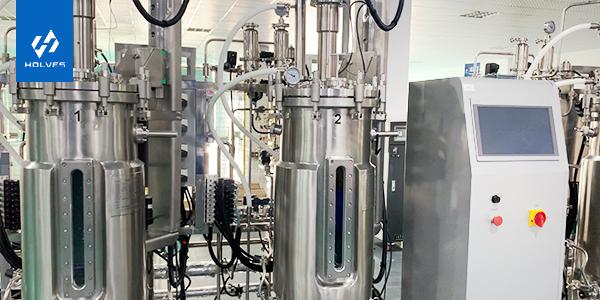
In the fermentation industry, fermenters are often used as vessels for research or production process trials.Usually, fermenters are divided into several types such as cylindrical, flat-bottomed, slanted-bottomed and flat-bottomed. For different types of fermenters, the bottom structure is also different.
Cylindrical fermenter
Cylindrical fermenter is developed on the basis of cylindrical container. Its basic structure is cylindrical, and the thickness of the cylinder has different designs according to the usage requirements.Cylindrical vessels can be divided into: small, medium and large according to its diameter; according to its volume: 500L ~ 1000L, 2000L ~ 5000L and 10,000L ~ 50,000L; according to its pressure is divided into: atmospheric pressure and reduced pressure.
This type of fermenter is suitable for large and middle-scale fermentation production, and can also be used in the process of sterilizing liquids or gases.
Flat-bottomed fermenter
In a flat-bottomed fermenter, microorganisms are able to grow and multiply both on the bottom of the vessel in contact with the liquid and on the walls.This type of fermentation is best suited for fermenters employing microorganisms as the culture medium. However, it is less effective in separating yeast and solid impurities.Therefore, for this type of fermentation, it is necessary to take certain measures to improve the contact conditions at the interface between the solid particles and the liquid, so as to ensure that the solid particles can spread evenly in the liquid.In order to improve the mass transfer rate of microorganisms in the vessel, it is also possible to increase the gas-liquid contact area by means of a bottom setup, i.e., an aeration device.
Slant bottom fermenter
The bottom of a slanted-bottom fermenter creates a fluid flow through the vessel walls at an inclined angle.The advantage is that there is no support structure inside the vessel, which is easy to operate and can meet the requirements of microbial growth and product synthesis in the fermentation process. However, its mechanical strength is lower than that of flat-bottomed fermenter.
At present, the slant-bottom fermenter is widely used in the fermentation industry. It is suitable for a variety of fermentation process tests and research in the production process.
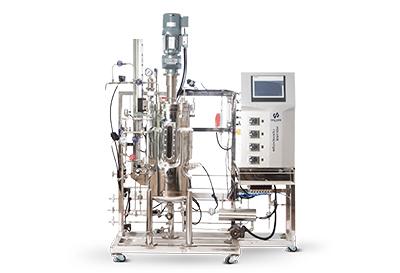
Here is the Holves brand website, https://www.bjholves.com/. Providing different types of industry information, technical knowledge, and solutions, we have developed and produced several new laboratory fermenter, bioreactor, tangential flow filtration system and other equipment to meet your needs from experimental to industrial production.
More questions to solve?
More Questions
More Questions
[Microcarriers] Q: What are microcarriers, and what role do they play in cell culture? A: Microcarriers are a type of microspherical scaffold used in cell culture. Typically ranging in size from 50-350 m in diameter, these carriers provide a surface for cells to adhe...
[Stainless Steel Fermenters] HOLVES Su310 intelligent stainless steel fermenter is a new generation of pilot and small-scale production equipment, integrating hardware innovation and intelligent control. In the pharmaceutical industry, stainless steel fermenters are crucial for p...
[Microcarriers] Microcarrier (Microcarrier) means a class of microspherical scaffolds with a diameter of 50-350 m and a density slightly higher than that of water, which have biological functions such as cell culture, proliferation and delivery. During the process of...
[Bioreactors] A bioreactor precisely controls key process parameterssuch as temperature, pH, dissolved oxygen (DO), and agitation speedto provide optimal growth and metabolic conditions for microorganisms, animal and plant cells, or enzymes. This enables efficient ...
[Bioreactors] Biological Reactions in Bioreactors: Advanced Solutions for Efficient Fermentation...
[Ceramic Membrane Filtration] Ceramic membrane filtration is a physical separation process that uses ceramic materials with porous structures to separate particles, microorganisms, and dissolved substances from liquids....
[Tangential Flow Filtration] The Application of Tangential Flow Filtration Cassettes...
[Photobioreactor] Photobioreactors are specialized cultivation systems designed to grow photosynthetic microorganisms such as microalgae, cyanobacteria, and other photosynthetic cells under controlled environmental conditions. Lab-scale photobioreactor systems serve as...
[Four-Piston Diaphragm Pumps] What is a Four-Piston Diaphragm Pump? How Does a Four-Piston Diaphragm Pump Work? What Are the Key Advantages of Four-Piston Diaphragm Pumps?...
[Fermenters] Optimizing Fermenters for Enhanced Production...
