In Part I, we discussed why high-cell-density fermentation can suddenly hit a wall when the growth curve looks most promising. Despite adequate oxygen supply, cell growth can stall due to the accumulation of metabolic by-products. There is no universal inhibition threshold: it can shift with the microbial strain, culture medium, pH, and specific growth rate.
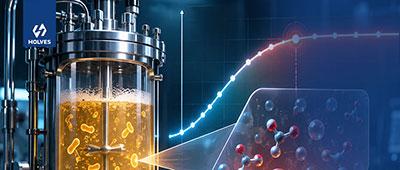
This article addresses one question: once the problem has been identified, in what order should corrective actions be taken?
There are several approaches available, but applying them all at once is not advisable. Effective intervention follows a clear sequence of priorities.
There are several approaches available, but applying them all at once is not advisable. Effective intervention follows a clear sequence of priorities.
-
Optimize the Feeding Strategy — The Lowest-Cost, Fastest-Acting Approach
When by-product inhibition occurs, the first step is often to revisit the feeding schedule. Staying within the intended total feed quantity does not necessarily mean that the feeding profile is appropriate. Delivering the same amount of feed gradually or over a short period places different metabolic burdens on the cells.
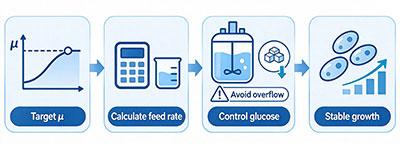
- Synchronize feeding with cell growth to avoid alternating periods of substrate starvation and excess.
- Dynamically adjust the feed rate according to actual cellular substrate consumption to reduce metabolic overload.
- Conventional pH-triggered feeding (pH-stat feeding), without an upper feed-rate limit, can result in excessive sugar addition under high-cell-density conditions and exacerbate by-product accumulation.
There is no universally optimal feeding strategy. Each approach has its own range of applicability. Selection should account for the microbial strain, culture medium, mixing capability of the fermenter, and available online monitoring capabilities, rather than simply replicating parameters from the literature.
-
Use Online Process Control for Real-Time Adjustment
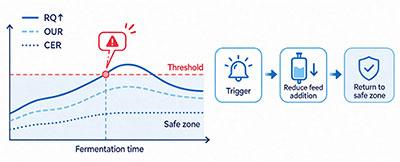
Once the feeding strategy has been established, online signals can be used to coordinate adjustments to the feed rate and other process parameters, bringing cellular metabolism back within a safe operating range.
Some details must be resolved before implementation. For example, how much should the feed rate be reduced when an early warning signal appears? How long should the reduction be maintained? When the signal returns to normal, should feeding immediately return to its previous rate, or should there be a delay? These decisions need to be established during early process development.
Some details must be resolved before implementation. For example, how much should the feed rate be reduced when an early warning signal appears? How long should the reduction be maintained? When the signal returns to normal, should feeding immediately return to its previous rate, or should there be a delay? These decisions need to be established during early process development.
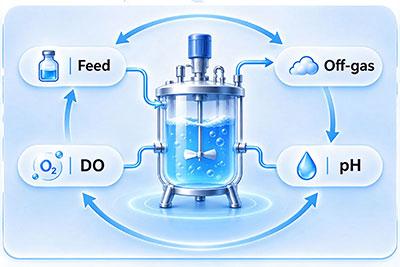
Even the most advanced algorithms require clearly defined control logic. Such adaptive, coordinated control also requires a fermenter control system capable of executing the predefined actions.
-
Reserve Strain Engineering as a Last Resort
Screening for highly tolerant strains or genetically engineering existing strains can improve cellular tolerance to by-products. For example, key genes in by-product formation pathways can be knocked out to reduce by-product generation, or pathways for by-product reassimilation can be enhanced to enable cells to utilize metabolites that have already accumulated.
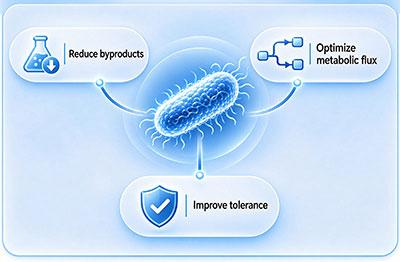
Strain engineering, however, should not be used to compensate for an inherently unsuitable feeding strategy. Genetic modifications may also introduce new metabolic burdens. Resolving one problem does not guarantee that new by-products or bottlenecks will not emerge.
The appropriate sequence is to optimize the process first, then use strain engineering to pursue even higher cell densities.
The appropriate sequence is to optimize the process first, then use strain engineering to pursue even higher cell densities.
-
The Strategy Is Ready — Can Your Fermenter Execute It?
The preceding sections outline the order of process adjustments. Whether these adjustments can actually be implemented depends on the capabilities of the equipment.
Some laboratory fermenters lack off-gas analysis modules and automated control programs that coordinate multiple process parameters. A feeding strategy may be well designed, only for operators to discover during fermentation that pump speed can only be adjusted manually. Obtaining RQ estimates may require waiting for offline gas chromatography results. By the time those results are available, the cells may already have passed the critical point at which intervention was needed.
Some laboratory fermenters lack off-gas analysis modules and automated control programs that coordinate multiple process parameters. A feeding strategy may be well designed, only for operators to discover during fermentation that pump speed can only be adjusted manually. Obtaining RQ estimates may require waiting for offline gas chromatography results. By the time those results are available, the cells may already have passed the critical point at which intervention was needed.
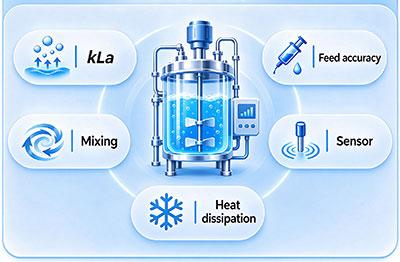
This puts process engineers in a difficult position: they know an adjustment is necessary, but either lack timely data or have equipment that cannot execute the required action. Such limitations should be considered during equipment selection.
Process strategies can be constrained by hardware capabilities. This is not a flaw in the process itself, but a consideration that should be addressed proactively when selecting equipment.
However, more capable equipment alone is not the answer. The ceiling of high-cell-density fermentation is often determined not merely by the oxygen supply capacity of the equipment, but by the metabolic capacity of the cells themselves. Even advanced fermenter hardware cannot readily counteract by-product inhibition resulting from metabolic overload. What truly makes a difference is the ability to detect metabolic risks sensitively and intervene at the right time.
*An upstream–downstream consideration: fermentation broth from high-cell-density processes contains high biomass concentrations and complex constituents. Elevated levels of upstream by-products directly increase the processing burden on subsequent tangential flow filtration (TFF) and membrane-based separation and purification. Upstream fermentation control has a direct impact on the difficulty of downstream purification.
If you are evaluating equipment for online monitoring capabilities or feed-rate control accuracy in high-cell-density fermentation, or would like to discuss the suitability of tangential flow filtration for processing high-cell-density fermentation broth, please send us a message. We can review the options with you based on your specific process requirements.
Want know more news information?
More News


Break the ceiling by optimizing feeding, adding online control, and saving strain engineering for last. ...
Read article "High-Density Fermentation (Part II)"
Why Does High-Density Fermentation Suddenly “Stop Growing”? By examining self-inhibition via metabolic byproducts, th ...
Read article "High-Density Fermentation (Part I)"
OD600 measures all light-scattering particles and does not equate to the number of viable bacteria. The optical method tr ...
Read article "Online Monitoring of Viable Cell Concentration in Fermentation"
Energy conservation in aerobic fermentation focuses on optimizing the coordination of agitation and aeration, on-demand o ...
Read article "How Can Fermenters Save Energy?"
Continuous biomanufacturing overcomes the bottlenecks of batch production and drives the industry toward high efficiency ...
Read article "Why Choose Continuous Manufacturing"
Analyze four types of faults, including drift and delay in the fermentation process, and propose a closed-loop solution i ...
Read article "Common Issues and Solutions for MFM in Fermentation"