Ask yourself this question—and you already know the answer: when was the last time you actually knew, with certainty, how many viable cells were in your fermenter?
For most people, the answer is "I don't know." It’s not that they don’t care; it’s just that there’s no way to measure it.
There are very limited ways to assess bacterial growth. Open the flask, take a sample, and measure the OD600 offline. This process has been followed for over a decade, and few people have ever questioned what exactly it measures.
For most people, the answer is "I don't know." It’s not that they don’t care; it’s just that there’s no way to measure it.
There are very limited ways to assess bacterial growth. Open the flask, take a sample, and measure the OD600 offline. This process has been followed for over a decade, and few people have ever questioned what exactly it measures.
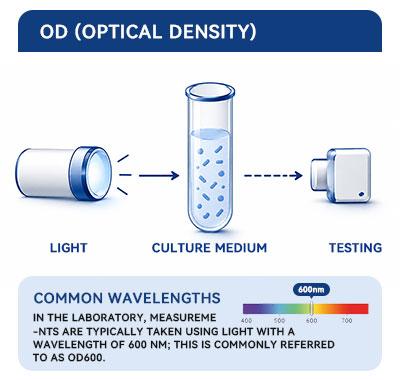
In the mid-to-late stages of high-density fermentation, the substances blocking light include not only live bacteria but also dead cells, cell debris, and undissolved solids in the culture medium.
That smooth upward growth curve you record may owe half its rise to things that are not even alive.
What's more, every sampling event breaks the sterile barrier. Data points are sparse, results are delayed, and contamination risk accumulates with every valve opening.
We have long treated OD600 as a proxy for "viable cell count," but it never was.
This is not an operational error; it is a tool limitation.
That smooth upward growth curve you record may owe half its rise to things that are not even alive.
What's more, every sampling event breaks the sterile barrier. Data points are sparse, results are delayed, and contamination risk accumulates with every valve opening.
We have long treated OD600 as a proxy for "viable cell count," but it never was.
This is not an operational error; it is a tool limitation.
-
Basic Parameters Reflect the Environment, Not the Cells Themselves
Many assume that fermentation online monitoring is limited to temperature, pH, and dissolved oxygen.
These parameters are certainly important. They maintain the macroscopic steady state—keep temperature from drifting, oxygen from dropping, and tank pressure from going abnormal. Without them, fermentation cannot proceed.
But they answer one question: "Is the environment okay?"
They do not answer: "Are the cells still alive? How well are they performing?"
A mature online sensing system actually covers two levels:
Level 1 – Routine basic parameters: temperature, pH, tank pressure, agitation speed, exhaust O₂/CO₂ concentration. These are the life-support systems of fermentation, but they cannot see what is happening inside the cells.
Level 2 – Advanced core parameters: capacitance-based viable cell concentration, oxidation-reduction potential (ORP), online viscosity, and real-time glucose/lactate concentrations.
This level directly touches the "lifeline" of fermentation: cell viability, metabolic state, and substrate consumption rate. Among these, capacitance-based viable cell detection is the online technology that can directly and precisely distinguish live from dead cells and provide quantified results.
It is this technology that elevates fermentation monitoring from "Is the environment normal?" to "Are the cells healthy?"
-
Two Technical Approaches, Not a Replacement
Currently, two main technical routes exist for online viable cell detection:
Optical method (online OD sensor): The principle is identical to offline OD600—a probe inserted into the tank measures light scattering or transmission. Advantages: direct and relatively low cost. Disadvantages: bubbles and cell debris severely interfere with the signal, making it difficult to distinguish live from dead cells in later stages.
Capacitance method (dielectric spectroscopy): Utilizes the capacitance properties of viable cells under an alternating electric field. Advantages: high specificity—responds only to cells with intact membranes, and is largely unaffected by bubbles and debris. Disadvantages: requires strain-specific calibration upfront, and the single-unit hardware cost is higher, though it supports a multi-probe configuration to share costs across multiple vessels.
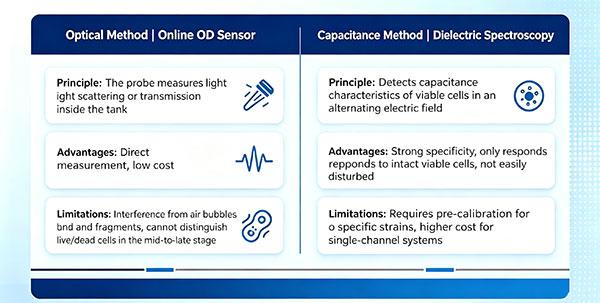
The two routes do not replace each other—they complement each other.
The optical method is suitable for trend tracking during early rapid growth. The capacitance method proves its irreplaceable value in the mid-to-late stages, when precise viable cell numbers are truly needed. When both run online simultaneously, the "divergence point" between the two curves often marks exactly the subtle transition from growth phase to decline phase.
-
What the Capacitance Method Actually Measures
In simple terms.
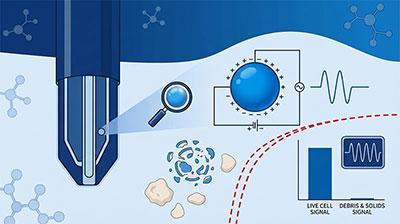
Viable cells have intact cell membranes. In an alternating electric field, an intact membrane behaves like a tiny capacitor—the membrane acts as the dielectric insulator, and the conductive fluids inside and outside the cell serve as the two plates. As the electric field rapidly reverses direction, these "micro-capacitors" charge and discharge repeatedly, generating a measurable signal.
Once a cell dies, its membrane ruptures, intracellular contents leak out, and this capacitive structure disappears.
Cell debris, lysed fragments, and insoluble particulates in the medium produce almost no signal in the electric field.
Thus, the capacitance sensor inherently possesses a biological filter: it counts only membrane-intact viable cells, ignoring everything else.
After strain-specific linear calibration, the capacitance signal can be directly converted into viable cell density (cells/mL) or dry cell weight concentration (g/L).
Applications
Microcarrier adherent culture: In animal cell and stem cell microcarrier cultures, traditional sampling requires digestion followed by offline counting, which disrupts the microcarrier structure and the cellular microenvironment, leading to experimental interruption and data distortion. The capacitance method requires no sampling and no contact with the sample. It captures the membrane capacitance signal of adherent cells in real time, accurately calculates viable cell numbers and growth rates, and maintains a sterile, closed culture system throughout—making it well suited for refined cell culture applications.
Viable cells have intact cell membranes. In an alternating electric field, an intact membrane behaves like a tiny capacitor—the membrane acts as the dielectric insulator, and the conductive fluids inside and outside the cell serve as the two plates. As the electric field rapidly reverses direction, these "micro-capacitors" charge and discharge repeatedly, generating a measurable signal.
Once a cell dies, its membrane ruptures, intracellular contents leak out, and this capacitive structure disappears.
Cell debris, lysed fragments, and insoluble particulates in the medium produce almost no signal in the electric field.
Thus, the capacitance sensor inherently possesses a biological filter: it counts only membrane-intact viable cells, ignoring everything else.
After strain-specific linear calibration, the capacitance signal can be directly converted into viable cell density (cells/mL) or dry cell weight concentration (g/L).
Applications
Microcarrier adherent culture: In animal cell and stem cell microcarrier cultures, traditional sampling requires digestion followed by offline counting, which disrupts the microcarrier structure and the cellular microenvironment, leading to experimental interruption and data distortion. The capacitance method requires no sampling and no contact with the sample. It captures the membrane capacitance signal of adherent cells in real time, accurately calculates viable cell numbers and growth rates, and maintains a sterile, closed culture system throughout—making it well suited for refined cell culture applications.
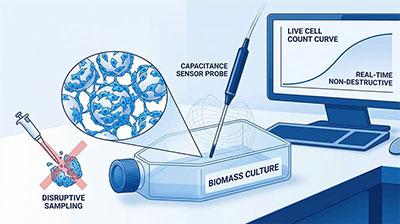
High-density fed-batch fermentation: Industrial fermentation commonly uses complex media containing corn flour, soybean meal, starch, etc., which are rich in solid particulates and cell debris that seriously interfere with optical measurements. The capacitance sensor responds only to intact viable cells; solids and bubbles contribute virtually no signal, demonstrating exceptional signal stability in turbid, particle-laden environments.
Multi-vessel parallel operation and scale-up consistency: A major challenge in process scale-up and production is the large data variability between parallel fermenters, compromising process consistency. The capacitance method supports a single host unit connected to multiple probes, enabling side-by-side comparison of biomass across vessels. This allows rapid identification and precise locking of optimal parameter windows, significantly improving process stability and production pass rates.
If you have read this far, it shows you truly care about the question "How many viable cells are actually there?"
The article may end, but the considerations around measurement tools are worth keeping for future reference. We suggest you save this article—the next time you encounter abnormal OD curves or unexpected drops in product expression, come back to the section on "the divergence point between optical and capacitance methods," cross-check it against your process stage, and you may find your answer there.
We would also like to sincerely ask two questions—they take just ten seconds to answer:
What detection method are you currently using—offline OD, online OD, or capacitance?
Have you ever experienced a situation where OD readings looked normal, but the final product yield did not meet expectations?
Want know more news information?
More News



OD600 measures all light-scattering particles and does not equate to the number of viable bacteria. The optical method tr ...
Read article "Online Monitoring of Viable Cell Concentration in Fermentation"
Energy conservation in aerobic fermentation focuses on optimizing the coordination of agitation and aeration, on-demand o ...
Read article "How Can Fermenters Save Energy?"
Continuous biomanufacturing overcomes the bottlenecks of batch production and drives the industry toward high efficiency ...
Read article "Why Choose Continuous Manufacturing"
Analyze four types of faults, including drift and delay in the fermentation process, and propose a closed-loop solution i ...
Read article "Common Issues and Solutions for MFM in Fermentation"