If you have worked with high-cell-density fermentation, you have probably encountered this puzzling scenario: optical density (OD) keeps climbing, feeding proceeds normally, oxygen supply is adequate, and microscopic examination shows no signs of contamination. Then, seemingly overnight, the growth curve comes to an abrupt halt. The growth rate plummets, dissolved oxygen (DO) rebounds, pH fluctuates unpredictably, and biomass stops increasing.
The first instinct is often to question the fermenter or the culture medium and repeatedly troubleshoot the hardware. Yet one critical factor is easily overlooked: the cells may be constrained not by external conditions, but by the by-products of their own metabolism.
The real bottleneck in high-cell-density fermentation is often not oxygen availability, but self-inhibition caused by the accumulation of metabolic waste products.
-
Why Does Cell Growth Stall When Oxygen and Sugar Are Abundant?
The objective of high-cell-density fermentation is straightforward: to maximize biomass or product output within the smallest possible vessel volume. Microbial metabolic networks, however, are not inherently designed to operate at high cell densities.
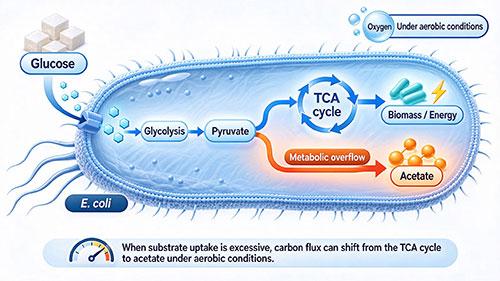
Take Escherichia coli (E. coli), for example. Even under fully aerobic conditions, when the glucose uptake rate exceeds the oxidative capacity of the tricarboxylic acid (TCA) cycle, carbon flux is diverted from pyruvate toward acetate formation through overflow metabolism. This is not anaerobic fermentation caused by insufficient oxygen, but metabolic overload under aerobic conditions.

In Saccharomyces cerevisiae, the problem takes the form of ethanol accumulation. Ethanol is not merely an end product of fermentation. At elevated concentrations, it can damage cell membranes and inhibit metabolic enzymes. Fermentation efficiency can decline substantially well before widespread cell death occurs.
In simple terms, excessive substrate uptake leads to metabolic overload and by-product accumulation, leaving cells inhibited by their own metabolites.
-
Three Hidden Forms of Inhibition That Undermine Fermentation
Fermentation stagnation is not necessarily caused by the acute toxicity of a single compound. More often, it results from the combined effects of multiple stressors.
2.1 Substrate inhibition: When feeding does more harm than good
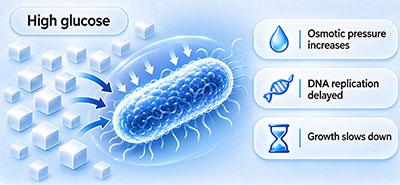
More nutrients do not necessarily mean better feeding. Poorly controlled feeding can cause sudden spikes in local sugar concentration, increasing osmotic pressure and subjecting cells to osmotic stress. Repeated sugar concentration spikes can continuously disrupt normal cell proliferation.

2.2 Product inhibition: Productivity declines before lethal concentrations are reached
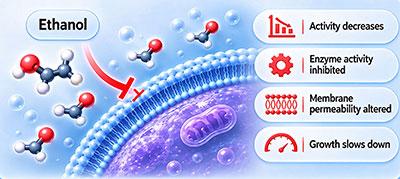
In yeast fermentation in particular, productivity can progressively decline once the product accumulates to a certain concentration, long before it becomes lethal to the cells. Tolerance varies considerably between strains, so process parameters established for one strain cannot simply be transferred to another.

2.3 Combined by-product effects: The most easily overlooked factor
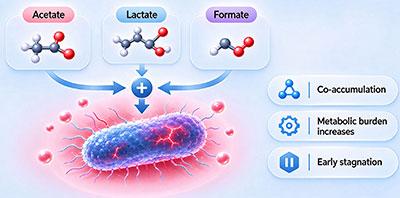
Beyond acetate and ethanol, which typically receive the most attention, fermentation also generates other organic acids. An individual by-product may have no apparent effect, yet multiple inhibitors acting together can exert cumulative inhibitory effects and cause fermentation to reach its limit prematurely.

-
Do Not Simply Copy the Literature: Inhibition Thresholds Are Process-Specific
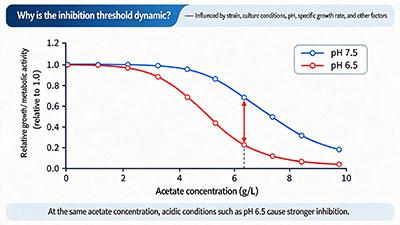
Reference conditions reported in the literature should not be adopted without validation. The severity of by-product inhibition varies dynamically with the microbial strain, culture medium, pH, and physiological growth state of the cells.

One practical pitfall is that by-products often impair target product expression before any noticeable deterioration in cell growth occurs. By the time OD stops increasing, target product losses may already have occurred. At the same by-product concentration, inhibitory effects can become substantially more severe at lower pH.
Rather than memorizing reference values, process developers should establish the critical limit for their own system: the cellular sugar uptake rate must not exceed the cells’ metabolic processing capacity. Once that limit is exceeded, by-product accumulation is only a matter of time.
-
Waiting for Test Results Before Taking Action May Be Too Late
One challenge in high-cell-density fermentation is that the inhibitory effects of metabolic by-products are almost imperceptible in the early stages. Conventional offline sampling and analysis involve a time lag. By the time results confirm excessive by-product concentrations, the optimal window for process adjustment may already have passed, wasting valuable fermentation time.
Online off-gas analysis offers an effective means of early warning.
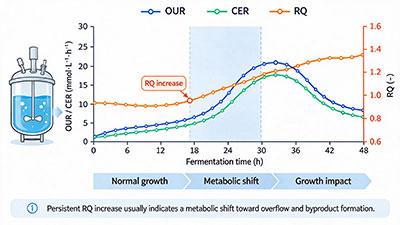

Off-gas measurements can be used to calculate the oxygen uptake rate (OUR), carbon dioxide evolution rate (CER), and respiratory quotient (RQ). Changes in these indicators can help detect shifts in metabolic activity at an early stage. In yeast cultures, changes in RQ can indicate the onset of substantial ethanol production. In E. coli cultures, acetate overflow metabolism is often accompanied by unusual fluctuations in OUR and CER, although such fluctuations are not specific to acetate overflow.
An important caveat: off-gas signals provide early warning indicators, not definitive diagnoses. Fluctuations in agitation and dissolved oxygen, as well as other disturbances, can also affect OUR, CER, and RQ. No single parameter should be interpreted in isolation. These signals must be assessed in the context of overall fermentation conditions and cannot completely replace offline sampling.
The core value of online monitoring is the shift from reactive troubleshooting to proactive intervention at the first signs of metabolic disturbance.
To implement this early warning approach, however, the fermenter must support off-gas analysis and data logging, capabilities that basic equipment may lack. If pump speed can only be adjusted manually and RQ estimates depend on offline gas chromatography results, even the best early warning strategy may remain purely theoretical.
At what stage have you encountered growth stagnation in high-cell-density fermentation? Have you used off-gas signals to detect metabolic disturbances early? Share your experiences in the comments.
In the next article, we will discuss the sequence of corrective actions once the problem has been identified, along with equipment limitations and scale-up constraints that are often overlooked in process design.