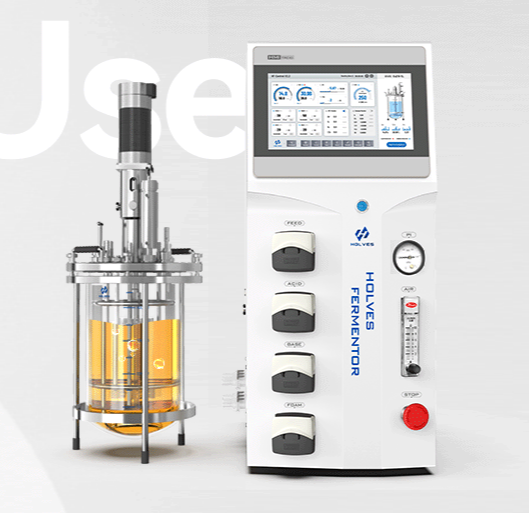
The maintenance and servicing of fermenter system can be divided into two ways, routine and regular. Neither can do without the other.
Routine maintenance (the monitoring content of the equipment in operation should be recorded accordingly)
- Whether the system pressure and vessel pressure are stable in the specified range.
- Whether the stirring system, temperature control system, sound of solenoid valve is normal.
- Whether the color of culture fluid is normal.
- Whether the temperature and dissolved oxygen pH display parameters are in line with the settings.
- Whether the liquid level in the vessel is normal.
- Whether there is leakage in the valve pipe joints and each interface.
Regular maintenance
Every three mouth,the user need to make a comprehensive inspection and correction of the equipment. Disconnect all power, water and air sources. Check all sealing rings and sealing ends of the system carefully. If there is permanent deformation, aging, scratches, damage, must be replaced. Check the sterilization filter intact, broken, blockage phenomenon should be replaced. Motor carbon brush wear and rectifier, bearing, coupler, mixing system condition.
Check all switches, buttons, electrical appliances, electronic components, fixing screws and nuts of electrical controllers for looseness and heat generation.
Cleaning and maintenance of fermenter vessel
- Cleaning
Cleaning the vessel can be combined with water intake, motor agitation, heating together.If the water change for several times still can not clean, open the top cover with a soft brush to scrub the vessel parts.
The method is as follows: control the switch and power switch, remove the electrode, motor and its connecting plug. Unplug the air inlet hose condenser quick connection, remove the air inlet filter upper hose and connector. Remove the top cover together with the stirring vertically upwards and place it on a flat table, pad it well, do not collide with the shaft and impeller, and brush the vessel and internal parts with neutral detergent.
Note:The vessel cover can only grab the sleeve or top cover when moving and cleaning, not the mixing shaft, impeller and other easily deformed parts. At the same time of cleaning, the vessel and the export valve should be inspected for some O-ring seals, if permanent deformation, aging, scratches are found, they should be replaced in time. After cleaning and reinstalling, its appearance and vessel frame should be wiped dry with a rag. Tighten the six fastening screws of the lid, the force should be balanced and pay attention to the vessel and vessel seat gap balance. Glass fermenter vessel cleaning should be particularly careful, do not collide when disassembling; tighten the lid fastening screws, the force must be balanced, and pay attention to the gap balance, to avoid damage to the glass vessel body.
- Leakage test
Fermenter is not used for a long time
If the fermenter needs to be used again in the short term, it should be sterilized. Then pass in sterile air and keep pressure for use.
If you are ready to stop using it for a long time, you should sterilize it, then drain the water in the vessel , loosen the tightening screw of the vessel lid, take out the electrode and store it well, drain the remaining water from the vessel and the pipes, close all the valves and power supply, and put on the dust cover.
- PS:
- The output pressure of the steam generator should be checked and adjusted before sterilizing.
- The air pressure in the vessel should be checked during the sterilization process.
- The output pressure of the air compressor should be checked and adjusted before fermenting.
- The air pressure in the vessel should be checked during the fermentation process.
Please look forward to the next content about the maintenance and servicing of pH electrode, DO electrode, stirring system, sterilization system, filter, etc.
More questions to solve?
More Questions
More Questions
[Microcarriers] Q: What are microcarriers, and what role do they play in cell culture? A: Microcarriers are a type of microspherical scaffold used in cell culture. Typically ranging in size from 50-350 m in diameter, these carriers provide a surface for cells to adhe...
[Stainless Steel Fermenters] HOLVES Su310 intelligent stainless steel fermenter is a new generation of pilot and small-scale production equipment, integrating hardware innovation and intelligent control. In the pharmaceutical industry, stainless steel fermenters are crucial for p...
[Microcarriers] Microcarrier (Microcarrier) means a class of microspherical scaffolds with a diameter of 50-350 m and a density slightly higher than that of water, which have biological functions such as cell culture, proliferation and delivery. During the process of...
[Bioreactors] A bioreactor precisely controls key process parameterssuch as temperature, pH, dissolved oxygen (DO), and agitation speedto provide optimal growth and metabolic conditions for microorganisms, animal and plant cells, or enzymes. This enables efficient ...
[Bioreactors] Biological Reactions in Bioreactors: Advanced Solutions for Efficient Fermentation...
[Ceramic Membrane Filtration] Ceramic membrane filtration is a physical separation process that uses ceramic materials with porous structures to separate particles, microorganisms, and dissolved substances from liquids....
[Tangential Flow Filtration] The Application of Tangential Flow Filtration Cassettes...
[Photobioreactor] Photobioreactors are specialized cultivation systems designed to grow photosynthetic microorganisms such as microalgae, cyanobacteria, and other photosynthetic cells under controlled environmental conditions. Lab-scale photobioreactor systems serve as...
[Four-Piston Diaphragm Pumps] What is a Four-Piston Diaphragm Pump? How Does a Four-Piston Diaphragm Pump Work? What Are the Key Advantages of Four-Piston Diaphragm Pumps?...
[Fermenters] Optimizing Fermenters for Enhanced Production...
